
Gates County Probate Records Office
Probate matters in Gates County are handled by the Clerk of Superior Court, not by a separate probate court. North Carolina court materials use wills, estates, estates division, and special proceeding language for much of this work. The local office is at the Gates County Courthouse, where the Clerk of Superior Court maintains court records, receives estate filings, provides public terminal access, and handles paper files when the matter is in Gates County.
Probate records can include wills filed for probate, applications for probate, Letters Testamentary, Letters of Administration, summary administration petitions, small estate affidavits, year's allowance filings, inventories, annual and final accounts, notices to creditors, creditor claims, orders appointing personal representatives, guardianship estate materials, and special proceeding records. Some items may be public, while others can be sealed, restricted, or limited due to minor, guardianship, or mental health concerns.
Estates Division of the Clerk of Superior Court
Gates County Courthouse
202 Court St.
Gatesville, NC 27938
Mail: PO Box 31, Gatesville, NC 27938
(252) 357-1365
Monday-Friday, 8:30 a.m.-5:00 p.m.
Gates County Probate Terms
Estate files use terms that do not appear in many other court records. The terms below are basic labels used in wills, estate administration, and guardianship-related filings. North Carolina procedures may use more precise words on forms, but these definitions help distinguish the people and filings in a Gates County probate record.
- Testator
- A person who made a will.
- Executor
- A person named in a will to carry out estate duties after appointment.
- Intestate
- Dying without a valid will, which can change the estate procedure used.
- Personal representative
- The executor or administrator authorized to act for the estate.
- Guardianship
- A court-supervised arrangement for a person or estate that needs legal protection.
- Conservatorship
- A term used in some states for property management, but North Carolina Gates County research points to guardianship and estate proceedings instead.
Search Gates County Probate Records
Online probate searching starts with the North Carolina eCourts Portal. Use Smart Search by record number, party name, or decedent/estate name if indexed, then filter the location to Gates County. Case type and case status filters may narrow estate results when those filters are available. If the online result is incomplete, use the public self-service terminal at the clerk's office or ask about viewing the paper estate file.
Estate searches often need more than one name. A will or estate file may be indexed under the decedent, the estate caption, the applicant, a personal representative, or another party in a special proceeding. If a Portal search does not return the expected result, try a narrower Gates County location filter, then use the clerk's terminal or paper-file route before assuming no estate file exists.
- Search Portal by known record number, decedent name, estate name, petitioner, or party name.
- Use the Gates County location filter to remove unrelated statewide estate records.
- Check whether the result is an estate, special proceeding, guardianship, or related filing.
- For full file inspection, contact or visit the Gates County Clerk of Superior Court.
- Ask the clerk about copy, certified copy, and original will procedures before mailing documents.
North Carolina Guide & File supports selected probate interviews, including year's allowance, summary administration, and small estate administration. The manifest capture for Guide & File failed, so it is referenced as a link rather than displayed as an image.
Gates County Probate Forms
Probate filings are form-heavy. The research file identified two official Judicial Branch forms that are especially relevant to summary administration, plus Guide & File interviews for selected estate case types. Form fields should be checked against the current official version before filing because estate facts, standing, assets, debts, and clerk review all affect the correct filing path.
| Form | What It Asks For |
|---|---|
| Application for Probate and Petition for Summary Administration, AOC-E-905 | Decedent identity, applicant identity, will information, relationship or standing, assets and debts basis, oath, signature, and clerk action. |
| Petition for Summary Administration of Estate Without a Will, AOC-E-906 | Decedent identity, spouse or beneficiary relationship, intestacy facts, property, debts, statutory basis, verification, and clerk order. |
| Probate Guide & File interviews | Interactive questions for selected probate case types; exact fields depend on the interview. |
The AOC-E-905 Application for Probate and Petition for Summary Administration is assigned to this Gates County probate records page.
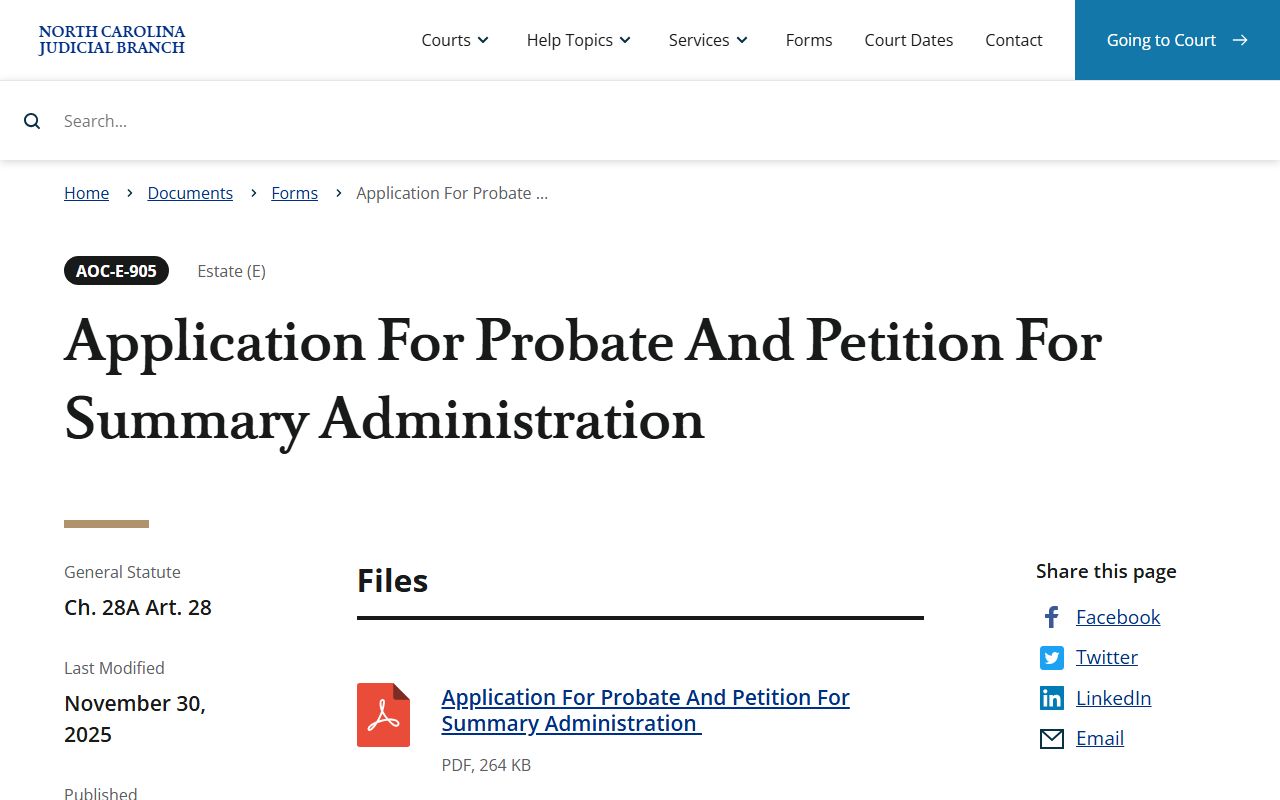
That form is tied to probate and summary administration when the facts fit the North Carolina procedure.
File Gates County Estate Papers
Estate work begins by deciding whether the decedent had a will and whether Gates County is the right county for administration. If the decedent lived in Gates County or owned property requiring North Carolina estate administration there, contact or visit the Clerk of Superior Court. The procedure may be full estate administration, small estate, summary administration, year's allowance, guardianship, or another special proceeding.
After the correct procedure is chosen, the filer may need to present the original will, the correct application or petition, and supporting facts. If statutory requirements are met, the clerk can issue letters or enter orders. The personal representative may then handle notices to creditors, inventories, claims, accountings, distributions, receipts, releases, and closing filings.
The AOC-E-906 Petition for Summary Administration of Estate Without a Will is the second successful probate image source assigned in the manifest.
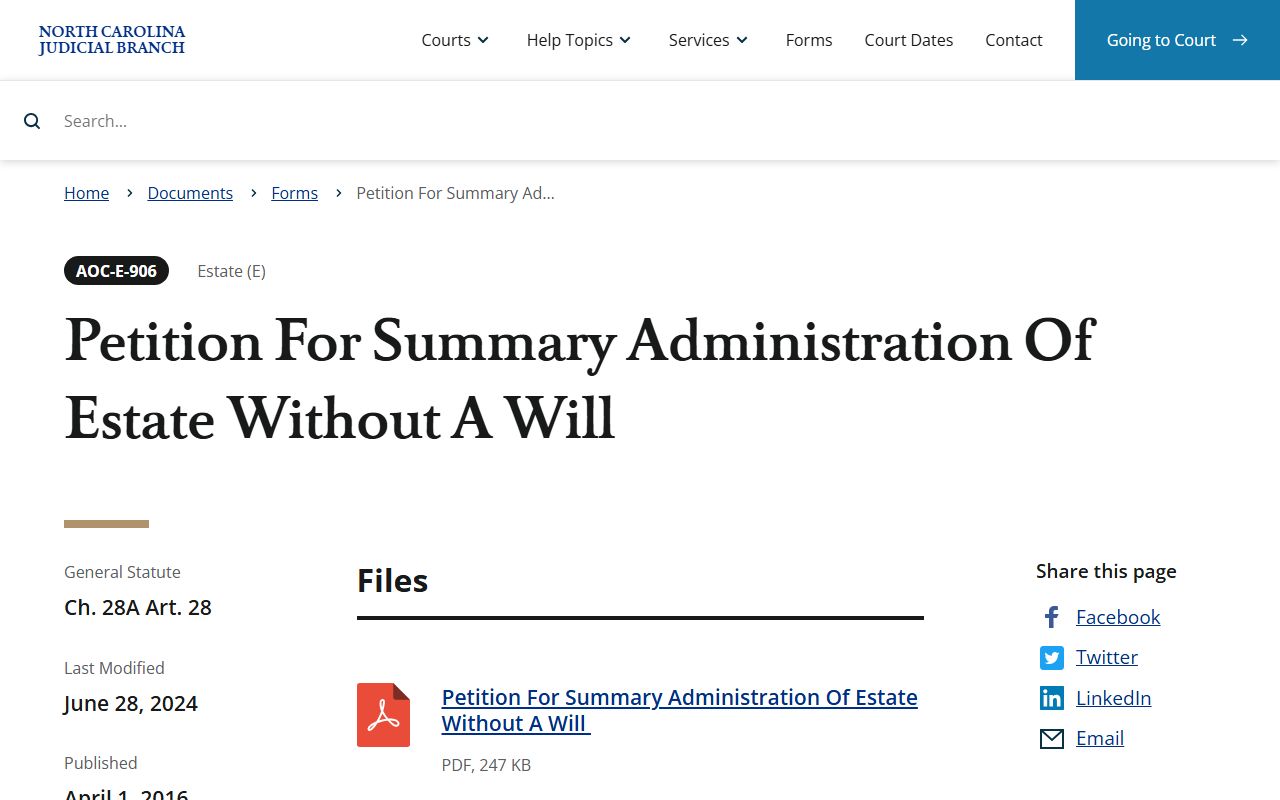
That petition applies to a different summary administration path, so the form choice should match whether a will exists and who has standing to file.
Gates County Probate Filing Fees
The captured Gates County research did not include current estate filing fees, certified copy amounts, or all probate-related charges. Court costs can change, and estate charges may depend on the procedure and assets involved. Confirm the current amount with the Clerk of Superior Court or the current Judicial Branch cost chart before filing or requesting certified copies.
| Item | Amount or Note |
|---|---|
| Estate filing / probate fees | Current amount not captured in Gates-specific research; confirm before filing. |
| Certified copies | Fee not located in captured Gates sources; ask the clerk for current copy cost. |
| Guide & File document preparation | Free service for selected probate interviews; filing fees may still apply. |
| Mailing original wills or pleadings | Confirm procedure with the clerk before mailing original documents. |
Note: Fee gaps are not a sign that probate is unavailable; they mean the current amount must be verified before payment.
Restricted Gates County Probate Records
Many estate files are public court records, but probate access is not unlimited. Guardianship materials, mental health matters, sealed filings, and records involving minors or protected persons can be restricted. The Judicial Branch also treats some involuntary hospitalization records as confidential in the context of court audio requests. Public terminals and Portal results may omit records or documents that are sealed or barred from public release.
Gates County probate records should also be separated from Register of Deeds records. Deeds, plats, survey maps, marriage licenses, and vital records belong to the Register of Deeds. Estate files, wills filed for probate, letters, inventories, accountings, and estate orders belong to the Clerk of Superior Court. For marriage certificates and license records, use the Gates County marriage and divorce records route instead.
Copies also depend on the status of the file. A public estate paper may be available for ordinary inspection or copy request, while a sealed order, restricted guardianship filing, or confidential mental health matter may require legal authority or a court order. Older files and paper-only documents can also take more time for clerk staff to retrieve.
Local routing: Gates County probate records are handled by the Clerk of Superior Court's Estates Division, not a standalone county probate court.